
Overview
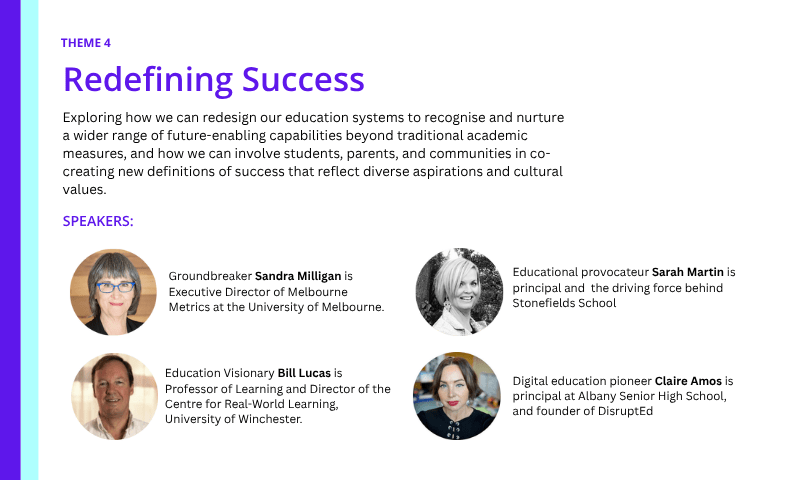
This theme focuses on recognizing and nurturing a broader set of future-enabling capabilities beyond traditional knowledge-based metrics. It emphasises the need for education systems to evolve, incorporating diverse forms of assessment that capture the full spectrum of student growth and achievement. Such as shift involves practical challenges of transitioning from established success metrics to more holistic ones, particularly the concerns of stakeholders who value traditional measures.
This approach aligns with research-backed frameworks that integrate academic knowledge, cognitive skills, and social-emotional capacities. It also resonates with the OECD’s Future of Education and Skills 2030 project, which aims to equip students with competencies to tackle unforeseen societal challenges and use yet-to-be-invented technologies.
By embracing alternative assessment tools and methods such as micro-credentials, rubrics, and progressions, we can move beyond standardised testing and exams. This shift allows for a more personalised, nuanced and comprehensive evaluation of student capabilities, including critical thinking, problem-solving, collaboration, and innovation. It also includes building rich portfolios of evidence that showcase learning across all aspects of life to support a more holistic view of student development and success.
Presenters in more detail
| Sandra Milligan | Sandra is Executive Director of Melbourne Metrics at the Faculty of Education, University of Melbourne. She directs several research partnerships with school networks and organisations working to develop Learner Profiles for their students. She is lead author of ‘Future Proofing Australian Students with New Credentials’ report, outlining methods to reliably assess and recognise the level of attainment of general capabilities. |
| Bill Lucas | Bill is Professor of Learning and Director of the Centre for Real-World Learning, University of Winchester. He is a researcher, writer and educational thought-leader. His model of creativity is now in use in more than 20 countries across the world. Bill is co-chair of the new PISA 2022 Test of Creative Thinking and co-author of the recent Durham Commission Report on Creativity and Education. |
| Claire Amos | Claire is Principal at Albany Senior High School. She is also co-founder of DisruptED and also sits on the board of NetSafeNZ. Claire also enjoys contributing to a wide range of advisory boards and reference groups. Claire was also a founding council member for the Education Council, Aotearoa, NZ |
| Sarah Martin | Sarah is Principal at Stonefields School. She is an educational ‘provocateur’ who thrives on problem-solving, conceptualising solutions, developing and implementing strategy, maintaining change momentum, building individuals’ and team capacity, and challenging teachers’ and leaders’ mindsets and thinking. As an experienced school leader, she has significant expertise to draw upon, and a strong desire to improve outcomes for all. |
Provocations:
- “How might we create assessment systems that honour both traditional academic measures and future-enabling capabilities while remaining equitable, accessible, and meaningful for all learners?”
- “What processes could involve students, parents, iwi, and communities in co-creating definitions of success that reflect diverse cultural values and aspirations while maintaining educational rigor?”
 EdRising