
Overview
The Digital Futures theme focuses on the rapidly evolving landscape of technology in education, particularly the increase of virtual and online education, and the rise of artificial intelligence (AI) and its implications for teaching and learning. Digital technologies are not merely enhancing traditional educational approaches—they’re fundamentally transforming what’s possible in teaching and learning by creating entirely new modes of knowledge creation, collaboration, and personalization that were previously unimaginable.
This theme addresses the critical need to develop digital citizens who are not only prepared for the digital world but can also thrive in it. It emphasizes the importance of digital literacy as a core competency for students and educators alike, while recognizing that the most powerful educational experiences emerge when technological innovation is balanced with meaningful human connection. The challenge is not choosing between technology and human relationships, but thoughtfully integrating digital tools in ways that deepen rather than diminish our connections with one another.
In this era of technological advancement, there’s a pressing need for schools and educators to embrace the transformative potential of digital technologies while maintaining the interpersonal foundations of effective teaching and learning. This includes leveraging virtual education opportunities to improve access for learners, regardless of their geographical location or personal circumstances, while ensuring these digital spaces foster genuine community and connection.
By focusing on Digital Futures, our aim is to understand how digital technologies can fundamentally reshape education while equipping learners with the skills to navigate the digital landscape critically and creatively. This approach seeks to bridge the digital divide, transform learning experiences, and prepare students for a future where digital competence and human connection are equally integral to personal and professional success
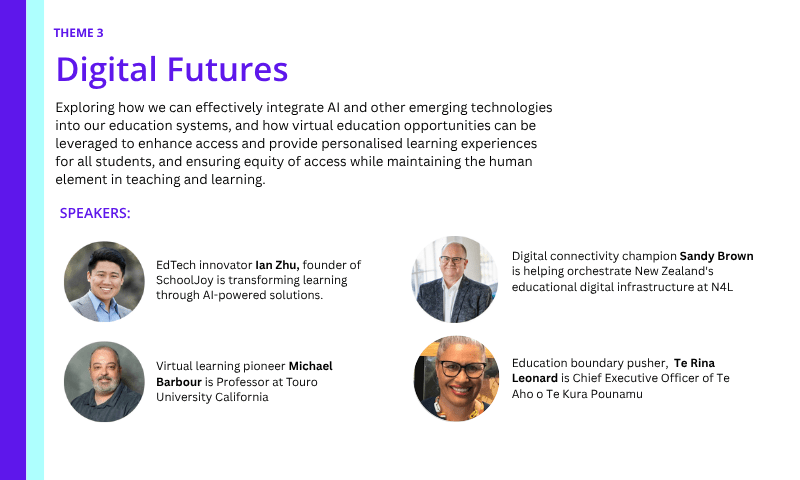
Presenters in more detail
| Ian Zhu | Ian Zhu is an inclusive education innovator. He is the co-founder and CEO of SchoolJoy, an AI-powered education management platform. The platform supports schools by reducing busy work while improving student outcomes and bringing much-needed relief to teachers and administrators across the country. |
| Michael Barbour | Michael is Professor of Instructional Design and Director of Faculty Development for the College of Education & Health Services, Touro University California. He has been involved with K-12 online learning in a variety of countries for well over a decade as a researcher, teacher, course designer and administrator. Michael’s research focuses on the effective design, delivery and support of K-12 online learning, particularly for students located in rural jurisdictions. |
| Sandy Brown | Sandy is Chief Government Affairs Officer @ Network for Learning. He creates teams and systems to innovate and deliver new ideas, systems and strategies. He thrives in complex, ambiguous environments, and works best moving across boundaries: from public to private; from the centre to the margins; from ideas to execution. |
| Te Rina Leonard | Te Rina is chief executive of the country’s biggest school, Te Aho o Te Kura Pounamu, formerly the Correspondence School. She is unashamedly optimistic about the potential of people, especially young people, to create powerful positive change in our world. I love working with other people to challenge the status-quo and create alternative ways of seeing and being in the world that leads to a collective improvement for all. |
Provocations:
- “How can we leverage AI and emerging technologies to fundamentally transform educational experiences while ensuring equity of access, strengthening human connections, and developing critical digital citizenship?”
- “What balance of virtual and in-person learning creates the most resilient and accessible education system for all learners, and how might this vary across different communities and contexts?”
 EdRising